You Don't Quit Journaling Because You're Lazy. You Quit Because Someone's Reading.
A 1986 writing experiment, twelve years of building camera apps, and the one condition almost every journal breaks.
In 1983, a psychologist named James Pennebaker and his graduate student Sandra Beall gave a group of college students an odd assignment. Write about the most upsetting events of your life for 15 minutes, four nights in a row. A comparison group wrote about trivial things.
The measure that made the study famous wasn't mood. It was the university health centre's records over the following six months. The students who wrote about upsetting events went to the health centre less. Pennebaker later recalled the rate as roughly half that of the control group.
It was a small study, and the authors called the results preliminary. Later research includes both replications and failures to replicate. But the method spread, and the standard instructions that grew out of it contain a line most journaling advice leaves out:
“All of your writing will be completely confidential.”
The promise came before a single word was written.
That one line is why I built Stillroom the way I did.
The polite version
Here's what it usually looks like. It's late, you open a journal, and there's something you actually want to say: a resentment you're embarrassed by, a decision you're scared of, something you'd never admit out loud. Your thumbs hover. Then you type: Busy day. Work was a lot. Feeling tired but okay.
Every word of that is true, and none of it is honest. The entry looks like a journal and does nothing a journal is supposed to do. After a few days of that, you stop, and you assume you lack discipline.
The problem usually isn't discipline. It's that you're writing for someone.
What is the imagined reader problem?
The imagined reader problem is what happens when you write a private journal as if someone will read it, and quietly edit yourself to suit them.
The reader is rarely a real person. It's usually one of these:
- Your future self, who you want to look back and approve.
- Someone who might find it: a partner, a parent, whoever picks up your phone.
- The company behind the app, and whatever it does with what you type.
- The person you're trying to become, who you'd rather not disappoint with how petty you still are.
Each one makes you a little more careful. Careful writing is the polite version, and the polite version is the one that never needed writing down. You do the work of journaling without the part that helps. Then you quit and call it laziness.
How do you write honestly in a journal?
None of this needs an app.
- Write the sentence you'd delete. Notice the line your thumb is about to backspace. Write that one, and keep going.
- Don't reread for a week. Rereading right away invites the editor back. A week later you'll notice instead of judge.
- Set a 15-minute timer and don't stop. It's the length the original study happened to use. Don't fix spelling and don't hunt for the right word.
- Start in the middle. Skip "Today I…". Open with the thought: I'm still angry that…
- Make the privacy real, not assumed. If part of you believes someone could read it, you'll write as if they will. Use a lock, a drawer, or a notebook that never leaves your bag, whatever makes you believe it.
The research is honest about one thing worth repeating: right after writing, people usually feel more distressed, not less, compared with writing about neutral topics. Honest writing tends to feel worse before it feels better. It isn't therapy, and for some people it can make things worse. If writing keeps making things worse, talk to someone.
Why a camera developer ended up building a journal
My day job is camera apps. For twelve years I've worked on making iPhone photos feel like film: grain weighted by brightness, light that blooms off highlights the way it does on real stock, and colour run through LUTs built from film. Nobody asks for any of that by name. They just say the photo feels real.
That work taught me something I didn't expect to need: texture changes behaviour before people can explain why. A white screen with a blinking cursor feels like a form to fill in correctly.
So when I built my own journal, Stillroom, I designed it against the imagined reader:
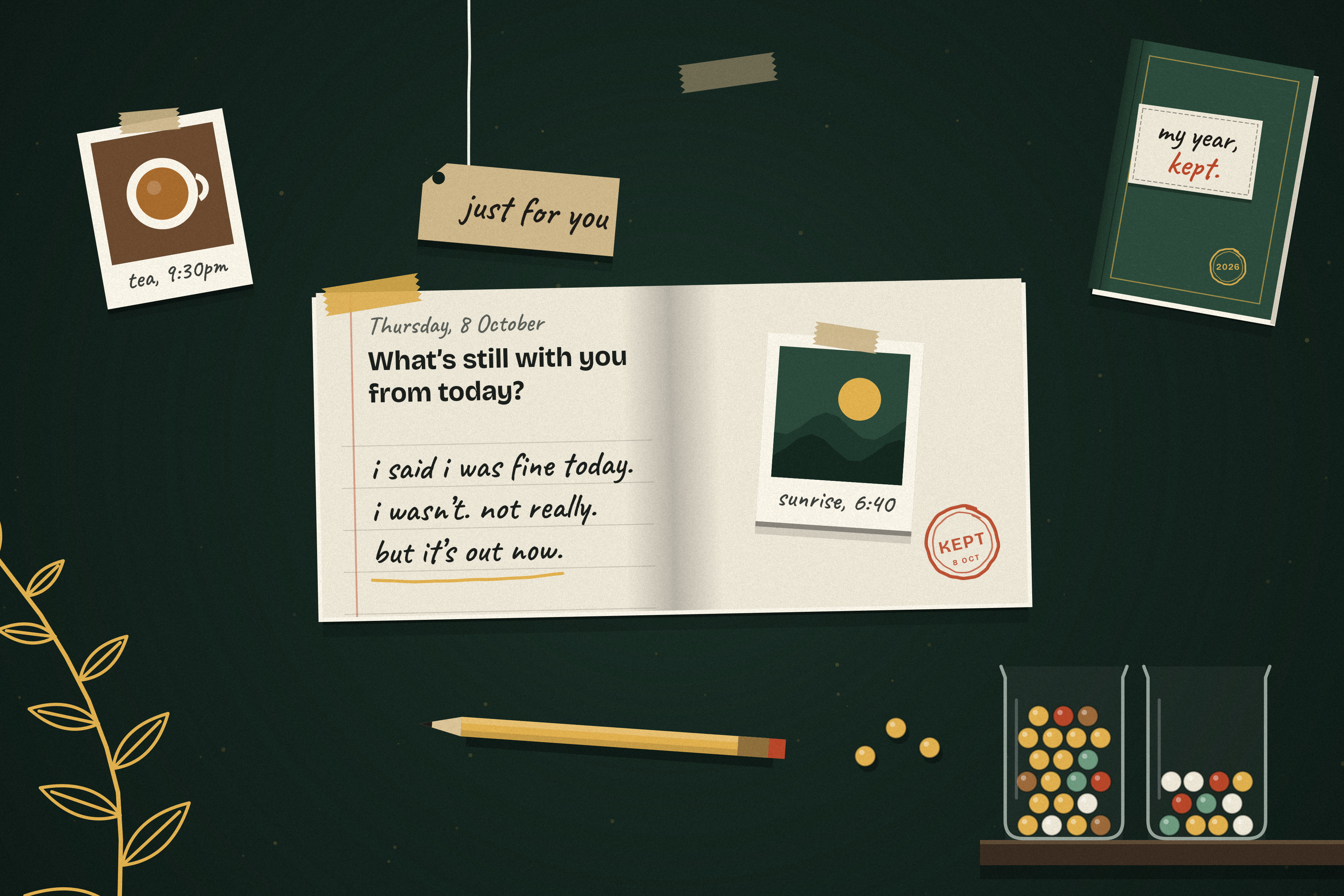
- The first screen says one thing: Write what you'd never say out loud. Entries stay on your phone, or in your own iCloud if you turn on sync. I can't read them.
- It looks like paper, tape and handwriting, because a crossed-out line looks normal on paper and looks like a mistake in a text editor.
- It asks you to write one line before it shows you anything you could pay for.
What I haven't solved yet is showing you what you've been working through, like the words that keep coming back, without turning your private writing into a dashboard. If I get that wrong, the app becomes one more reader.
The condition comes first
If you've quit journaling more than once, try the experiment before you try more discipline. Make sure nobody will read it. Then write the sentence you'd delete.
A journal built against the imagined reader.
If you want a journal built around that idea, Stillroom is on the App Store. A notebook in a drawer works too.
View Stillroom on App Store →Short answers
- Why do I quit journaling after a few days?
- Usually because you are writing for an imagined reader (your future self, someone who might find it, an app's company), so the writing turns polite and stops being useful.
- What is the imagined reader problem?
- Writing a private journal as if someone will read it, and quietly editing yourself to suit them.
- Does expressive writing actually work?
- Evidence is mixed. A small 1986 study found fewer health-centre visits among students who wrote about upsetting experiences; later trials include both replications and failures to replicate. It may help some people in some circumstances, and it can increase distress in the short term.
- How do I make a journal private enough to be honest?
- Make privacy something you believe, not just assume: a lock, a physical notebook, or an app whose developer cannot read your entries.
References
- Pennebaker, J. W., & Beall, S. K. (1986). Confronting a traumatic event: Toward an understanding of inhibition and disease. Journal of Abnormal Psychology, 95(3), 274–281.
- Pennebaker, J. W., Kiecolt-Glaser, J. K., & Glaser, R. (1988). Disclosure of traumas and immunofunction: Health implications for psychotherapy. Journal of Consulting and Clinical Psychology, 56(2), 239–245.
- Pennebaker, J. W., & Chung, C. K. (2011). Expressive writing: Connections to physical and mental health. In The Oxford Handbook of Health Psychology (pp. 417–437). Oxford University Press.